Showing posts with label NEPAL. Show all posts

Thursday, October 3, 2019

INDRA JATRA / YENYA

INDRA JATRA most commonly known as YENYA is the biggest religious street festival in Kathmandu, Nepal. "Ye" means Kathmandu and "Ya" means celebration. Thus, together it means celebration inside Kathmandu in Nepal Bhasa. The celebrations consist of two events, Indra Jatra and Kumari Jatra.


Statue of  Indra (God of Heaven, God of rain and good harvest) with his hands bound.
Indra's mother needed Paarijat, a type of flower, for some religious ritual so Indra came to the earth from the heaven disguised as a human being. But he was recognised when he was stealing the flowers. So the people caught him and tied him with ropes.

Swet Bhairava

Swet Bhairava

Swet Bhairava

Swet Bhairava

Swet Bhairava

Swet Bhairava

Kaal Bhairava

Kaal Bhairava

Kaal Bhairava

Samay Baji offered to Kaal Bhairava

Kaal Bhairava

Kaal Bhairava and Swet Bhairava

Kaal Bhairava and Swet Bhairava

Aakash Bhairava displayed outside the temple

Aakash Bhairava displayed outside the temple
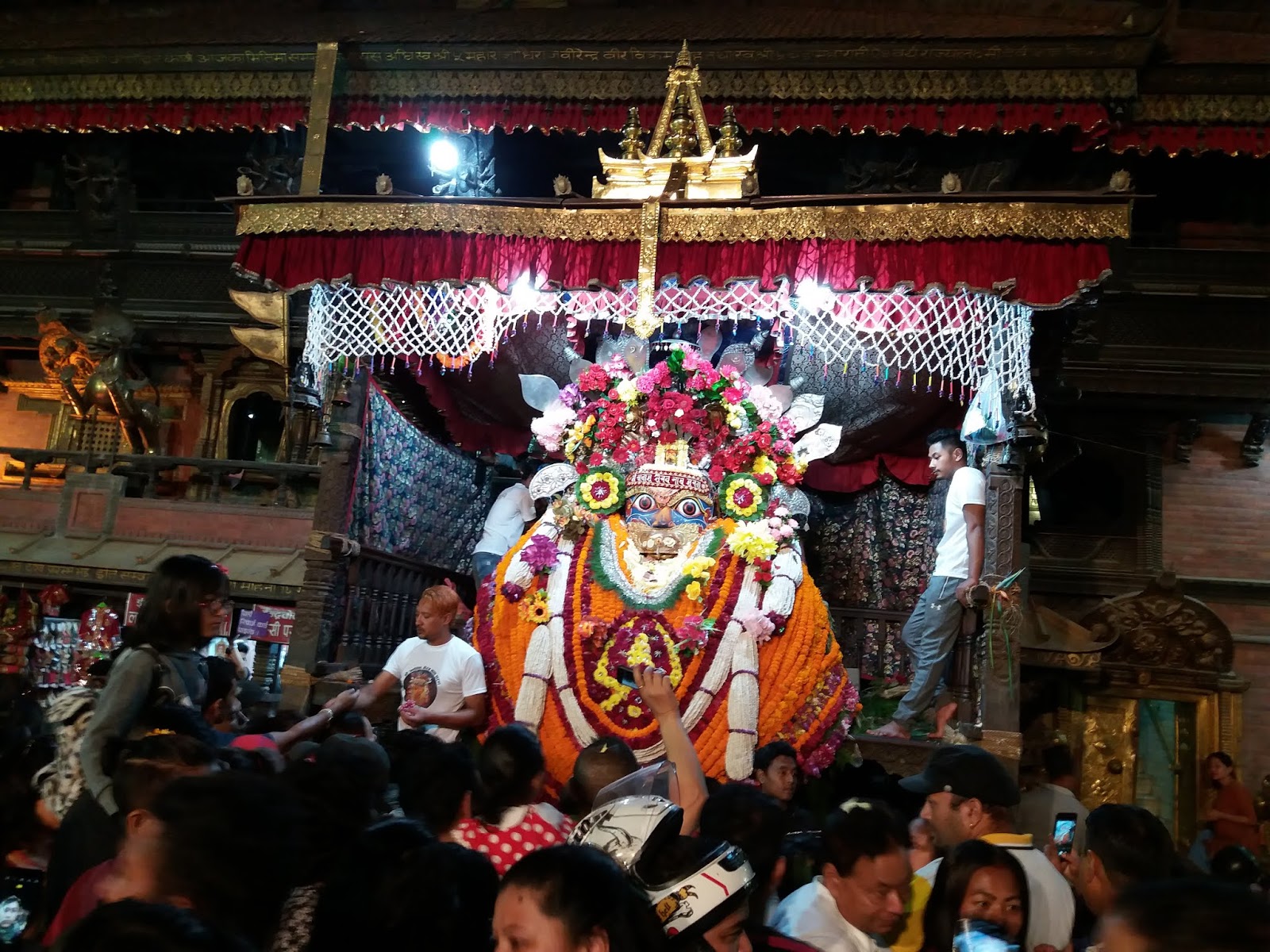
Aakash Bhairava displayed outside the temple

Baka Bhairava

Crowd of people gathered to observe the chariot processions of Shree Kumari, Shree Ganesh and Shree Bhairava


Majipa Lakhey performing dance

Majipa Lakhey performing dance

Pulu Kisi

Sawa Bhakku dance group
Bhairava in blue holding a sword and his two attendants in red

Sawa Bhakku dance group
Bhairava in blue holding a sword and his two attendants in red

Sawa Bhakku


Head of the State, the President of Nepal, Rt. Honourable Bidya Devi Bhandari along with other dignitaries observing the chariot processions of Shree Kumari, Shree Ganesh and Shree Bhairava from Gaddi Baithak  of Historic Hanumandhoka


Beautifully decorated chariot of Kumari being pulled away during chariot procession.
Two chariots of Ganesh and Bhairava precede while the bigger one of Kumari comes at the end of procession

Gaddi Baithak (damaged by earthquake in April 2015) after restoration, beautifully illuminated at night 

Information Collected from Various Sources

Saturday, June 1, 2019

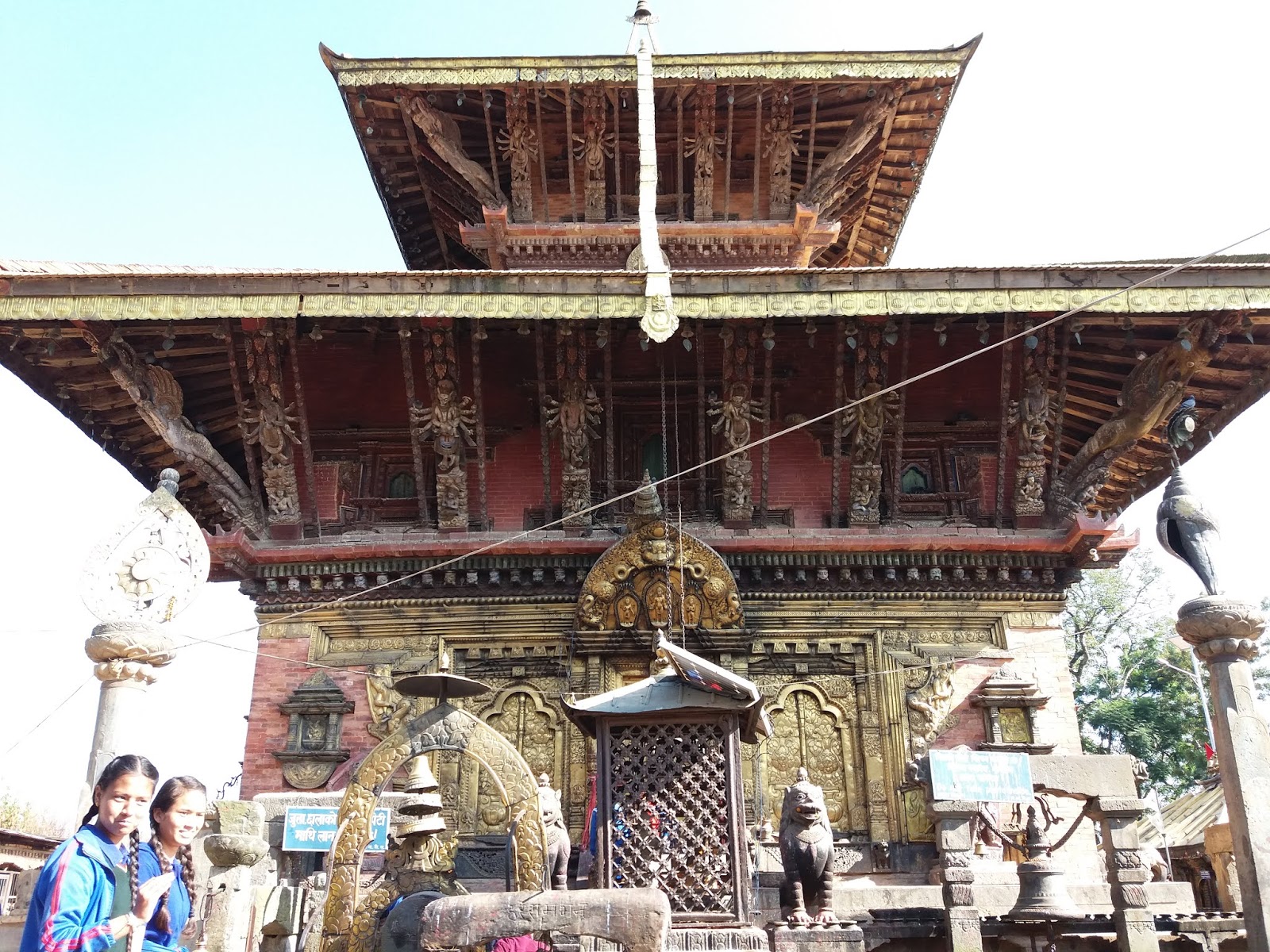
Photographs captured during CHANGU NARAYAN visit

The ancient Hindu temple of Changu Narayan is located on a high hilltop that is also known as Changu or Dolagiri. The temple was surrounded by Champak tree forest and a small village known as Changu. The temple is located in Changunarayan V.D.C. of Bhaktapur District, Nepal. The hill is about 12 km east of Kathmandu. The Manahara river flows beside the hill. The shrine is dedicated to lord Vishnu and held in special reverence by the Hindu people. This temple is considered to be the oldest temple in the history of Nepal.

Changu Narayan temple was originally built in the 4th century during Licchavi Dynasty. It was rebuilt in 1702 after a major fire occured. Today, the temple is a UNESCO World Heritage Site.

On the main way to the temple courtyard, we can find a human settlement. People from Newar community live in and around Changu Narayan area.

The temple is surrounded by sculptures and arts related to lord Vishnu. Also, we can find the temples of lord Shiva, Ashta Matrika, Chhinnamasta, Kileshwor and Krishna inside the courtyard of the main temple. There are four entrances to the temple and these gates are guarded by life size pairs of animals such as lions, sarabhas (a part lion and part bird beast in Hindu mythology), griffins (portrayed with the rear body of a lion, an eagle's head with erect ears, a feathered breasts, and the forelegs of an eagle, including claws) and elephants on each side of the entrances. The ten incarnations of lord Vishnu and the other idols are carved in the struts, which support the roof. The entrance door is gilded with carvings of Naaga (snakes). On the main entrance gate (i.e. western entrance gate), we can find the Chakra, Sankha, Kamal and Khadga all at the top of a stone pillar. These stone pillars have an inscription in Sanskrit. This inscription is considered to be the oldest inscription of Nepal and the stone inscription pillar was erected by Licchavi (kingdom) King Mandeva in 464 A.D. The following monuments are located while visiting the temple from the right side after entering from the main entrance (Eastern Gate) to the courtyard
-Historical Pillar: erected by Mandeva in 464 A.D.
-Garuda: flying vehicle of lord Vishnu which has got human face and is a devotee of Vishnu
-Statue of Bhupalendra Malla, king of Kantipur and his queen Bhuwan Lakshmi
-Chanda Narayan (Garuda Narayan): a 7th century stone sculpture of Vishnu riding on Garuda. This sculpture has been depicted in the 10 rupee paper note issued by Nepal Rastra Bank
-Sridhar Vishnu: a 9th century stone sculpture of Vishnu, Lakshmi and Garuda which stands on the pedestals of various motifs
-Vaikuntha Vishnu: a 16th century sculpture of Vishnu seated on the Lalitasan position on the six armed Garuda and Lakshmi seated on the lap of Vishnu
-Chhinnamasta: temple dedicated to Chhinnamasta Devi, who beheaded herself, offered her own blood to feed the hungry Dakini and Varnini
-Vishworup: a 7th century stone sculpture beautifully carved that depicts the scene from the Bhagwat Gita, in which lord Krishna manifests his universal form to his devotee Arjun
-Vishnu Vikrant: a 7th century sculpture of Trivikram Vishnu that depicts the scene of popular Hindu myth of lord Vishnu and his beloved Bali Raja
-Narsimha: a 7th century sculpture of Narasimha, an incarnation of lord Vishnu, killing the demon king Hiranyakashyapa to save his beloved devotee Prahalad
-Kileshwor: a small two storied temple of lord Shiva, who is believed to have appeared in this place for the protection of the hill

The main image in the sanctum is worshipped by Hindus as Garuda Narayan and by Buddhists as Hariharihari Vahan Lokeshwara. Only the priest is allowed to see the image.


The Changu Narayan temple from the eastern entrance

Eastern side of Changu Narayan temple

Western side of Changu Narayan temple
The main entrance gate of Changu Narayan temple

Northern side of Changu Narayan temple

Southern side of Changu Narayan temple

Idol of Lord Vishnu


Stone sculpture of Vishworup

Stone sculpture of Vaikuntha Vishnu

Information Collected from Various Sources

Friday, May 17, 2019

Photographs captured during KALINCHOWK BHAGAWATI TEMPLE visit in 2017

Kalinchowk Bhagawati Temple is a Hindu shrine located in Dolakha. It is situated at the altitude of 3842 meters above the sea level and 150 kilometers away from Kathmandu. It is a part of Gaurishankar Conservation Area from where the two rivers Sun Koshi and Tama Koshi originate.


Visited Kalinchowk Bhagawati Temple on the last week of January 2017. Walked from the place called Deurali due to heavy snow fall although road was accessible upto Kuri village. At first, began the day by visiting Dolakha Bhimsen Temple at around 7 a.m in the morning. After having breakfast, rode rented four wheeler jeep upto Deurali. 


Started our trek from Deurali at around 9 a.m. Walked through the hilly forest, climbed the Kalinchowk hill and reached the Kalinchowk Bhagawati temple at around 4 p.m. When reached back to Deurali, it was almost dark. Then rode the four wheeler upto the resort.

Trekked for more than 11 hours in a single day. Enjoyed a lot. Thankfully, didn't have to experience altitude sickness. It is one of the "once in a lifetime experience" that I have, ever, encountered.

Following are the few snaps that I have captured while travelling from Deurali upto Kalinchowk Bhagawati temple. Hope, you will enjoy the breathtaking view.    


NEPAL, beautifully engraved in the snow

At Deurali, upto where four wheeler took us

People enjoying the snowfall

People playing snow

Almost everything covered by blanket of snow

Large number of people marching on the way to Kalinchowk temple

People walking on snow on their way to Kalinchowk Bhagawati Temple

Almost everything covered by snow

People walking on snow on their way to Kalinchowk Bhagawati Temple

Almost everything covered by snow

Foot trails left behind by the hikers

View of Kuri village covered by snow

Kuri village

Kuri village

Kuri village

Kuri village as seen while climbing Kalinchowk hill

Kuri village as seen while climbing Kalinchowk hill

Snow peaked mountain ranges seen from Kalinchowk temple

View of Kuri village from Kalinchowk temple

View of Kuri village from Kalinchowk temple

Information Collected from Various Sources